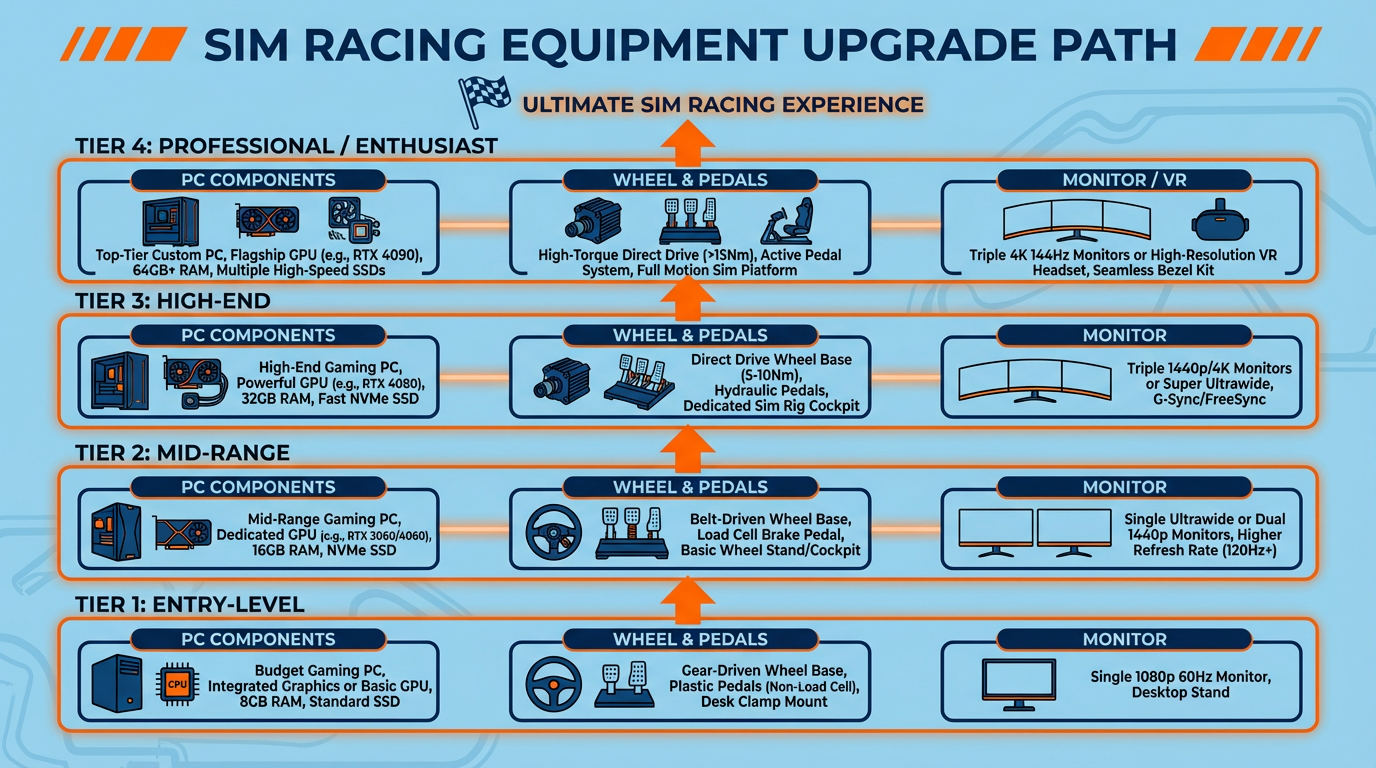
If you've already read our 2026 Sim Racing Setup Guide, you'll know that a rig should be built around you — your space, your goals, and your budget. This article picks up from there.
Once you know what kind of experience you want, the next question becomes what to upgrade first. Get that wrong, and even expensive hardware can feel underwhelming.
🔁 The Correct Sim Racing Upgrade Order
Many sim racers jump straight to a direct drive wheel or triple monitors and regret it later. The reason is simple: their system wasn't ready to support that upgrade.
| Step | Component | Why It Comes First |
|---|---|---|
| 1 | PC & Performance | Enables smooth visuals, VR, and stable frame rates |
| 2 | Cockpit / Rig | Foundation for torque, braking, and immersion |
| 3 | Displays | Must match PC performance and space |
| 4 | Pedals | Direct impact on lap time and consistency |
| 5 | Wheelbase | Adds immersion once the rig can handle it |
| 6 | Immersion Layers | Tactile, motion, sound, accessories |
1. 💻 PC & Performance — The Engine of Your Experience
Everything starts with your system. Your PC determines:
- Whether VR is viable
- Whether triples can run at proper FOV
- What refresh rates you can realistically hit
- How consistent braking, steering, and visuals feel
A powerful wheel won't fix stutter, dropped frames, or inconsistent visuals.
⚠️ What Most People Get Wrong
They buy VR without GPU headroom, triple monitors capped at 60Hz, or direct drive wheels while running unstable frame rates. The result is poor immersion, motion discomfort, inconsistent lap times, and frustration.
🎯 Target Frame Rates (2026)
- VR: 90–120 FPS (comfort, immersion)
- Triples: 120–144 FPS (awareness, responsiveness)
- Ultrawide: 100–144 FPS (smooth motion)
🧠 Recommended GPUs
- Ultrawide: RTX 4060 Ti / RTX 5060 / RX 7700 XT
- Triples: RTX 4080 Super / RTX 5080 / RX 7900 XTX
- VR: RTX 4090 / RTX 5090 / RX 8900 XT
💡 Your PC defines what upgrades are worth doing next — not the other way around.
2. 🧱 A Solid Cockpit — Rigidity Before Power
Force feedback only works if your rig can stay rigid under load. A solid cockpit:
- Prevents wheel flex and pedal movement
- Improves braking consistency and muscle memory
- Allows higher torque safely
- Reduces fatigue during long sessions
This is why many people feel a bigger improvement from upgrading their rig than from upgrading their wheel.
| Rig Type | Suitable For |
|---|---|
| Folding / Entry | Light gear, limited space |
| Aluminium Profile | DD wheels, load cell pedals, frequent use |
💡 If your rig flexes, everything upstream suffers.
3. 👁 Displays — Choose After You Know Your Capabilities
Display choice should come after you understand what your PC can handle, how much space you have, and how your rig will mount screens or VR.
💡 Displays amplify system strengths — they don't fix weaknesses.
4. 🦶 Pedals — Lap Time Lives Here
Braking consistency matters more than steering force.
🧠 Pedal Types
- Potentiometer: Affordable but inconsistent braking
- Load Cell: Pressure-based = massive control upgrade
- Hydraulic: Realistic feel, expensive, higher maintenance
💡 Good pedals + a modest DD wheel beat a premium wheel with poor pedals every time.
5. 🏎 Wheelbase — The Final Core Input
Direct drive wheels are excellent — when the rest of the system supports them. Don't upgrade yet if:
- Your cockpit flexes
- Your pedals lack consistency
- Your PC struggles to maintain frame rate
🔧 Torque Guide
- 5–8Nm: Casual racing, trucking
- 8–12Nm: Ideal for most racers
- 15Nm+: High realism, solid rig required
💡 Choose torque based on your rig and driving style — not ego.
6. 🪑 Immersion Layers — The Finishing Touch
Once the fundamentals are right, immersion upgrades shine:
- Tactile feedback (Buttkickers, transducers)
- Dashboards (SimHub, RPM displays)
- Motion platforms
- Sound systems
💡 One tactile transducer often adds more immersion per £ than most hardware upgrades.
🚫 Common Sim Racing Upgrade Mistakes
- Installing a DD wheel on a flexy rig
- Buying VR with insufficient GPU headroom
- Choosing triple 60Hz monitors
- Ignoring pedal quality
- Overlooking ergonomics and comfort
Avoid these and your experience improves immediately.
🏁 Final Thoughts
Sim racing isn't about buying the "best" hardware. It's about building a balanced system that is:
- Frame-rate stable
- Rigid and comfortable
- Upgraded intentionally
That system will always outperform a more expensive setup built on weak foundations.
Haven't planned your rig yet? Start here: Sim Racing Setup Guide 2026